I have been a consistent critic of survey “data” and polling, along with traditional measures of sentiment. There are many reasons for this: Half of Americans do not vote, so when they respond to polls they are making up answers. Even if they say they are going to vote, there is little reason to believe them. I don’t know who still has a landline, or who answers an unknown phone call on a cell phone, but I question if these folk represent broader America.
People responding to these polls are at best guessing — who will be on the ticket, who they will support, and most unknown of all, whether they actually will get out of the house and go to their local polling place to cast a vote on election day.
~~~
In the car on the way up to Grand Lake Stream and Camp Kotok, filled with interesting people, when this curious question came up on the polling/survey question:
“What do people actually know relative to what they believe they know?“
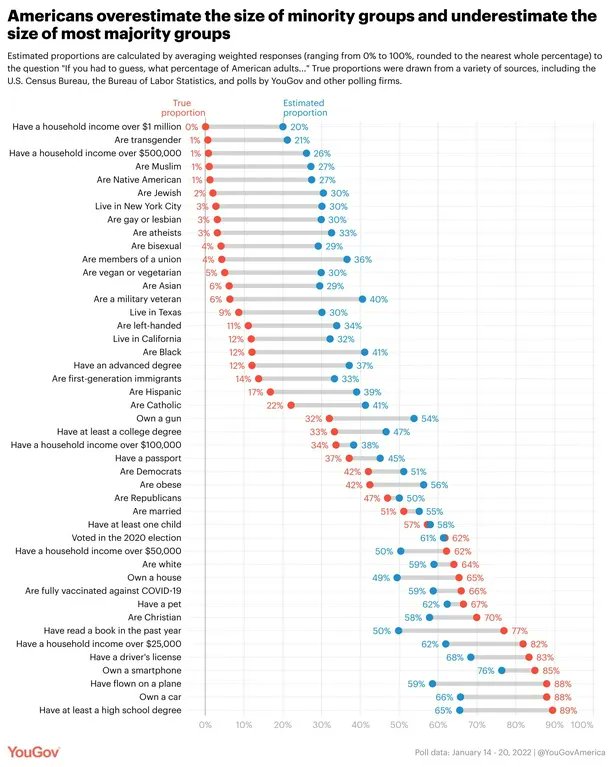
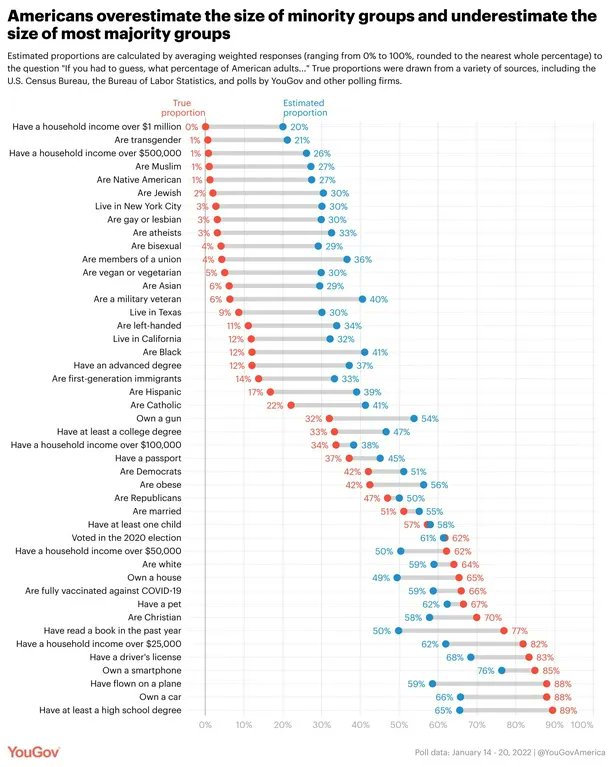
Tom Morgan of The Leading Edge raised this issue in response to a discussion of how under-utilized the phrase “I don’t know” is — especially but not exclusively in finance. Tom shared a fascinating analysis that looked at how people conceptualize other groups, whether by economic strata, behavior, race, religion, etc. Taylor Orth is Director of Survey Data Journalism at YouGov. They looked at what various people believed when it came to the size of different subgroups of Americans. There are two enormous takeaways from this. The first is simply how wrong people were. Two YouGov polls “Asked respondents to guess the percentage (ranging from 0% to 100%) of American adults who are members of 43 different groups, including racial and religious groups, as well as other less frequently studied groups, such as pet owners and those who are left-handed.” Americans vastly overestimate the size of minority groups, including sexual minorities, the proportion of gays and lesbians (estimate: 30%, true: 3%), bisexuals (estimate: 29%, religious minorities, racial and ethnic minorities, etc. And, people tend to underestimate majority groups. Looking at the chart above, we can see that the average answer ranges from very wrong to laughably wrong. None of this is complex or hard-to-find information; its all readily available to anyone who wants to know it, Our car full of economists and fund managers did pretty well answering Tom’s Q&A on what actual and estimated numbers were. But the second aspect of this is even more fascinating. Why don’t people say I DON’T KNOW when they don’t know? We discussed whether COVID-19 escaped from a Lab or the Wet Market. My answer: “As someone who is neither a virologist nor an intelligence operative, I do not have the tools needed to render an expert judgment about the origins of Covid.” Dave Nadig pointed out that “Social media has made it mandatory for everyone to have an opinion about everything.” We should all ask ourselves, Why? Previously: Learning to say “I Don’t Know” (September 9, 2016) What Do You Believe? Why? (June 29, 2023) Source: From millionaires to Muslims, small subgroups of the population seem much larger to many Americans by Taylor Orth March 15, 2022