
Produced by: Tarun Mishra Designed by: Manoj Kumar
Lost Islands Rediscovered Off Spanish Coast
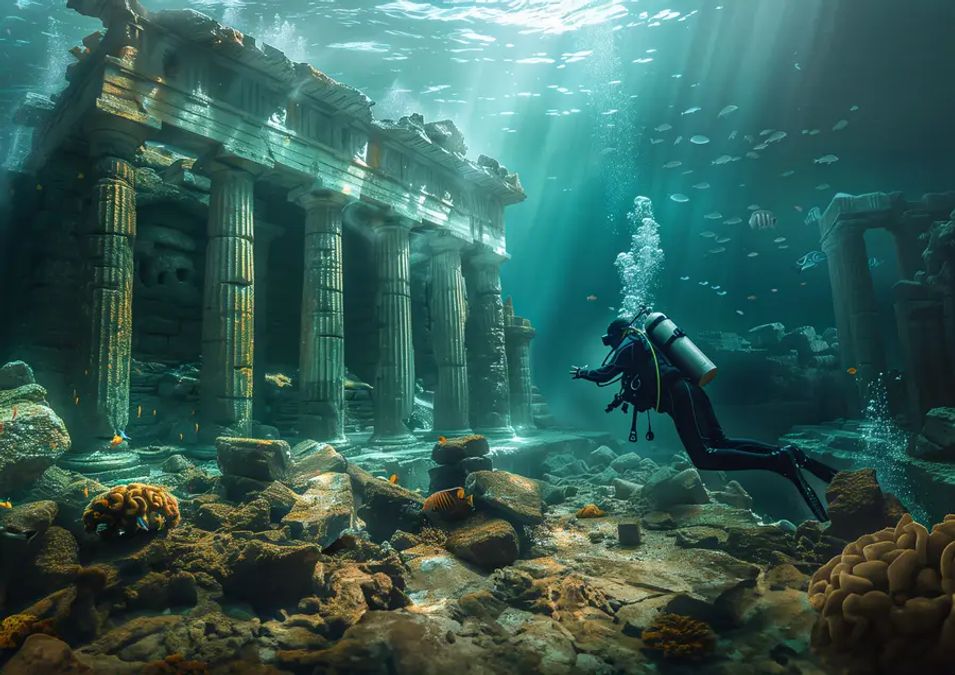
Researchers in Spain have rediscovered ancient islands that sank into the ocean millions of years ago. Remarkably, some of these islands still have intact beaches, despite being submerged.
Possible Link to Atlantis Legend
The discovery has led scientists to speculate that these islands could be the origin of the Atlantis legend, a mythical civilization said to have been submerged by the gods as punishment.
Exploration by Spanish Scientists
The discovery was made by a team led by Luis Somoza, head of a project studying volcanic activity near the Canary Islands. The team found the islands on an underwater mountain, or seamount, with nearly three inactive volcanoes.
Mount Los Atlantes: A Nod to Atlantis
The newfound seamount has been named Mount Los Atlantes, inspired by Plato’s fabled civilization of Atlantis. The legend describes a civilization that sank into the ocean, a fate similar to what happened to these islands.
Discovery Process
Scientists used a remotely operated vehicle (ROV) to explore the seabed near Lanzarote, in the Canary Islands, at depths ranging from 330 to 8,200 feet. This exploration was part of the Atlantis project by the Geological and Mining Institute of Spain (IGME-CSIC).
Geological Evidence from the Eocene Era
The researchers believe these islands were part of a series of islands from the Eocene era, approximately 56 to 34 million years ago. The flat summit of the seamount revealed beaches, cliffs, and sand dunes.
Significance of the Findings
The sand covering the volcanic rock suggests that these islands were actively sinking over time. Some beaches were found just 200 feet below the ocean surface, indicating that the islands were likely above water during the last ice age.
Wildlife Habitats and Volcanic Activity
Somoza noted that during periods of low sea levels, such as the last ice age, these volcanoes might have re-emerged as islands, potentially serving as habitats for wildlife. The islands eventually sank again as sea levels rose.