
Produced by: Tarun Mishra Designed by: Manoj Kumar
Historic Achievement
NASA’s Glenn Research Center successfully streamed 4K video footage from an aircraft to the International Space Station (ISS) and back using optical (laser) communications for the first time.
Technology Test
This milestone was part of a series of tests on new technology aimed at providing live video coverage of astronauts on the moon during the Artemis missions.
Laser vs. Radio Waves
Traditionally, NASA has used radio waves for space communication. Laser communications, which utilize infrared light, can transmit data 10 to 100 times faster than radio frequency systems.
Collaborative Effort
The project involved cooperation between the Air Force Research Laboratory and NASA’s Small Business Innovation Research program. Engineers installed a portable laser terminal on a Pilatus PC-12 aircraft for the tests.
Credit: NASA/Sara Lowthian-Hanna
Data Transmission Process
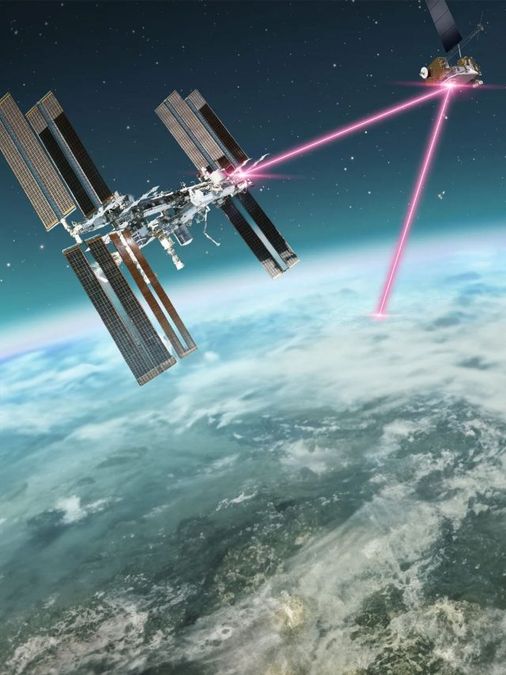
The aircraft flew over Lake Erie, sending data to an optical ground station in Cleveland. The data then traveled through an Earth-based network to NASA’s White Sands Test Facility in New Mexico, before being sent 22,000 miles into space to NASA’s Laser Communications Relay Demonstration (LCRD).
Relay to ISS
The LCRD relayed the signals to the Integrated LCRD LEO User Modem and Amplifier Terminal (ILLUMA-T) payload on the ISS, which then transmitted the data back to Earth.
Credit: NASA/Sara Lowthian-Hanna
New Communication System
The High-Rate Delay Tolerant Networking (HDTN) system, developed at Glenn, enhanced signal penetration through cloud coverage, ensuring reliable data transmission during the experiments.
Future Applications
According to Dr. Daniel Raible, principal investigator for the HDTN project, the success of these experiments paves the way for future capabilities like HD videoconferencing for Artemis astronauts, crucial for crew health and activity coordination.
Continued Testing
Although the ILLUMA-T payload is no longer on the ISS, researchers will continue to test 4K video streaming from the PC-12 aircraft through July, aiming to develop the technology needed to stream high-definition data from future lunar missions.