
Produced by: Tarun Mishra Designed by: Manoj Kumar
Discovery of Stormy Weather
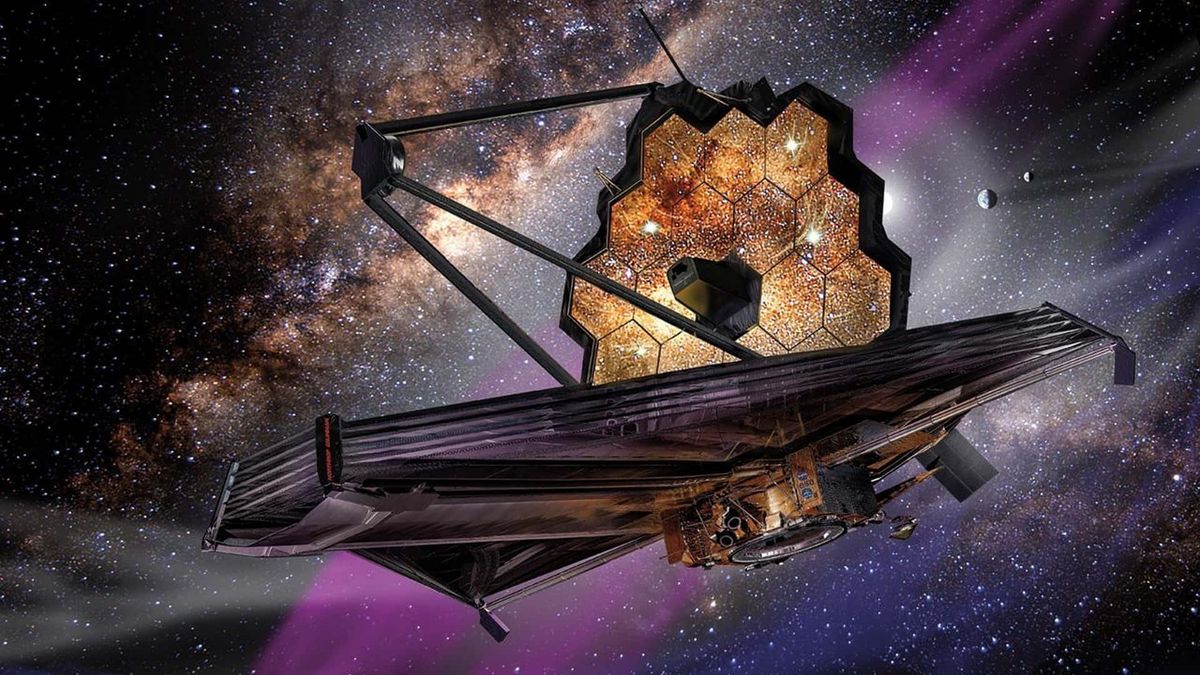
The James Webb Space Telescope (JWST) has observed stormy weather on two brown dwarfs, providing the most detailed weather report yet from these “failed stars.”
Closest Brown Dwarfs
The brown dwarfs, forming a binary pair called WISE 1049AB, are the closest to our sun at just 6.5 light-years away. They were discovered by NASA’s Wide-field Infrared Survey Explorer (WISE) in 2013.
Image credit: ESO/I. Crossfield/N. Risinger
Brown Dwarfs Explained
Brown dwarfs are objects not massive enough to sustain hydrogen fusion like stars but too massive to be considered planets. They form through gravitational collapse of gas clouds, similar to stars.
Previous Limitations
Earlier studies only provided time-averaged snapshots of brown dwarf atmospheres. These objects are fast rotators, and their atmospheric conditions change over time, which earlier observations missed.
Detailed Observations
A team led by Beth Biller from the University of Edinburgh used JWST’s Mid-Infrared Instrument (MIRI) and Near-Infrared Spectrometer (NIRSpec) to observe WISE 1049AB for a total of 15 hours, detecting changes over time.
Tumultuous Clouds
Both brown dwarfs exhibit tumultuous clouds likely composed of silicate grains, with temperatures ranging between 875°C (1610°F) and 1026°C (1880°F). Hot sand is essentially being blown by the winds on these brown dwarfs.
Chemical Signatures
The observations identified carbon monoxide, methane, and water vapor in the atmospheres of the brown dwarfs, with light curves showing considerable variability due to stormy conditions.
Atmospheric Layers
The light curves indicate different atmospheric layers with varying pressure levels. These include a deep layer, an intermediate altitude layer, and a high-altitude layer, each absorbing light at specific wavelengths.
Transforming Understanding
The study showcases JWST’s ability to probe atmospheric conditions at different depths of brown dwarfs. The researchers believe this is just the beginning, with future JWST observations set to enhance our understanding of brown dwarfs and giant exoplanet atmospheres, potentially even detecting weather on habitable exoplanets.