
Produced by: Tarun Mishra Designed by: Manoj Kumar
Mission Overview
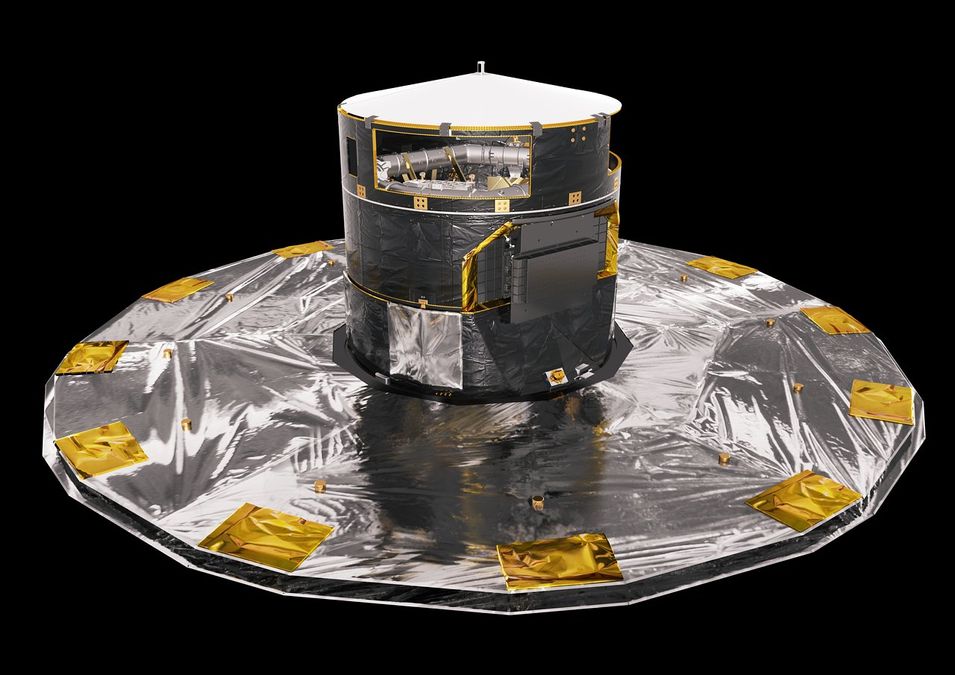
The European Space Agency’s (ESA) Gaia spacecraft, launched in December 2013, is tasked with mapping over a billion stars in the Milky Way from its position 1.5 million kilometers from Earth at the second Sun-Earth Lagrange point (L2).
Micrometeoroid Impact
In April 2024, Gaia was impacted by a high-speed micrometeoroid, smaller than a grain of sand. The collision damaged Gaia’s protective cover, creating a gap that occasionally allowed stray sunlight to interfere with its sensors.
Charge Coupled Device (CCD) Failure
In May 2024, Gaia suffered its first CCD failure in over a decade. This failure affected a key sensor responsible for star detection, leading to a surge in false readings. The malfunction coincided with a powerful solar storm that also triggered auroras on Earth.
Data Disruption
The combined impact of the micrometeoroid and CCD failure significantly disrupted Gaia’s data processing capabilities. The spacecraft, which typically transmits over 25 gigabytes of data daily, experienced an increase in false detections due to the malfunction and stray light.
ESA’s Response
Teams from ESA and Airbus Defence and Space collaborated to address the issues. They adjusted the thresholds in Gaia’s software to better identify stars and minimize false readings caused by the damage and CCD malfunction.
Technical Adjustments
Engineers used the opportunity of the spacecraft’s unscheduled downtime to refocus the optics of Gaia’s twin telescopes. This adjustment was done to enhance the quality of the data collected.
Current Status
Following the resolution of these issues, Gaia is now producing some of its highest-quality data to date. The mission continues to contribute valuable information about the stars in the Milky Way.
Ongoing Mission
Despite the recent challenges, Gaia’s mission remains on track. The spacecraft is expected to provide crucial data for understanding the structure and evolution of our galaxy.
Future Prospects
The resolution of these technical problems ensures that Gaia can continue its ambitious mission of mapping the stars and delivering valuable astronomical data.