India, the biggest democracy in the world!
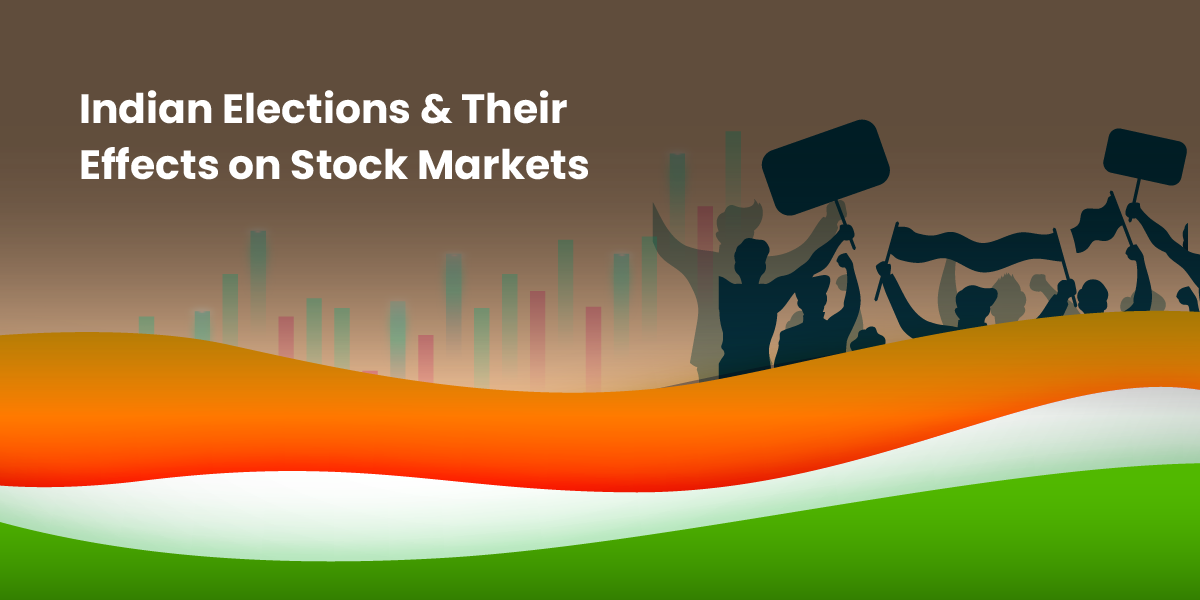
It is obvious that the elections are also of the largest scale and so will be the impact of Elections on the Indian stock markets!
General Elections, were the Lok Sabha members are elected and the Government is formed is nothing less than a festival in the country with a population of almost 1.5 Billion.
Every General Election result had a different impact on the markets. Some went with the expectations of people while few completely flipped.
Let’s go back in time and understand more!
Starting off with 1991
It was a time of extreme volatility and insecurity. A period when the Harshad Mehta Scam came to light. Let’s look at the bigger picture of the year.
After facing challenges like a high Gross Fiscal Deficit, inflation, and low forex reserves, things started looking up when Prime Minister P.V. Narasimha Rao came into power. The stock market, represented by the Sensex, bounced back by about 29% by the end of the year.
Under Rao’s leadership, the Congress party worked on boosting market confidence.
They did this by making changes, opening up the economy globally and drawing in international investors.
Unfortunately, the assassination of PM Rajiv Gandhi in 1991 added to the ups and downs in the market later.
Moving forward to the year 1999
The return of the NDA with the influential face of Mr Atal Bihari Bajpayee restored the nation’s faith.
The Sensex rose by about 7% as expected, leading to a three-month uptrend. This boosted the GDP growth rate to around 6-7%.
Thanks to the government’s efforts in reforms, opening up sectors and drawing in foreign investments, the economy picked up pace, keeping inflation in check and the market happy.
Next comes the Unexpected 2004
In 2004, the market was expecting a return of Mr Atal Bihari Vajpayee and NDA. However, the arrival of Congress marked the fall of the market by 15% in just 2-3 trading sessions due to the mismatch in expectations and the election outcome.
In 2009, UPA came back to power
The markets shot up by just 17% in one day, but due to previous market conditions, they remained unstable.
The 2008 Crisis shook up the entire global economy.
Even though people didn’t trust the global scenario much, the Sensex went up by 15.5% in the first three years.
2014 sees the Modi Wave
The investors gained confidence when the NDA won with a full majority. The Namo slogans and Modi Wave came out with flying colours even for the Indian Markets.
The market became less volatile, with its ups and downs decreasing from 17.96% to 9.1%, making trading more stable.
This happened because people expected the government to make economic changes and believed the NDA would bring stability.
The S&P BSE Sensex rose by 758.93 points, reaching an all-time high of 25,375.63 and hitting a low of 24,271.54 during trading. Following the exit, the domestic market weakened by 5%.
But even though the stock market grew by about 40% in the next four years, some experts thought it could have been faster, considering the NDA’s strong position.
2019
The stock market reacted to political news during the 2019 Indian election. Investors watched closely to see how the election could affect the economy.
During the 2019 elections, investors saw gains, while the Sensex dropped by 1314 points by the end of the day.
In the long term, after the election, the market went up a lot. Many important stock indices hit all-time highs.
This was because people expected the government to keep making changes and things to stay stable under the BJP.
2024, what to expect?
If there’s a surprise change in government like in 2004, markets could drop heavily.
Also, if BJP doesn’t win big, that might not excite investors.
But if the BJP wins by a big margin, markets could rally.
“Profit Booking can be seen. With a euphoria of expectation being set up for the ruling party winning 400+ seats, anything near the 2019 election’s numbers might serve as a trigger for a negative reaction.”-Bernstein
JP Morgan suggests that the Nifty50 might reach 25,000, mainly due to:
-If the current ruling party maintains power with a seat share that meets or exceeds expectations.
-If the RBI begins to ease policies amid favourable US and global economic conditions.
Investment Plan For The 2024 Elections
Although long-term investors should remain unaffected by any market fluctuation caused as an Impact of elections on Indian Stock Markets, short-term and swing traders should not miss this opportunity.
Analyse the sectors that can be directly or indirectly related to ruling party decisions.
Choose right stocks and build your portfolio so that it stands tall in a very volatile market. Read our blog on how to pick stocks for the 2024 Lok Sabha Elections to learn more!
Make your risk and reward analysis based on all the probable outcomes, and scenarios.
How to do it? StockEdge and Elearnmarkets are at your service!