
Produced by: Tarun Mishra
Discovery Announcement
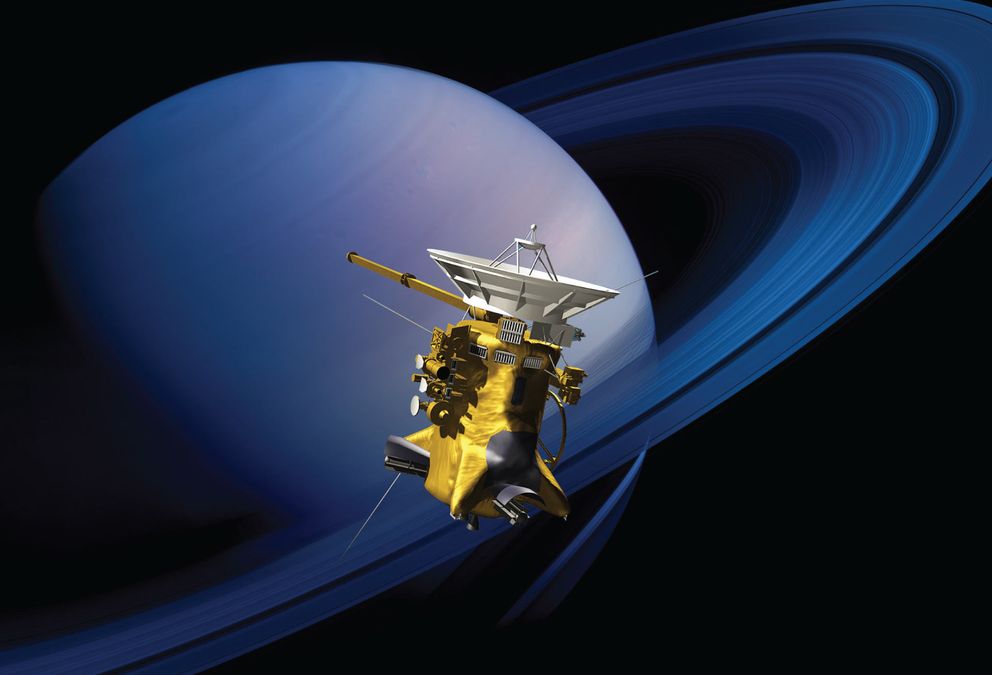
A recent study utilizing radar experiment data from NASA’s Cassini-Huygens mission to Saturn has unveiled fresh insights into the composition and behavior of the liquid hydrocarbon seas near Titan’s north pole, Saturn’s largest moon.
Research Team and Publication
Led by Cornell University, the research team, including Valerio Poggiali, published their findings titled “Surface Properties of the Seas of Titan as Revealed by Cassini Mission Bistatic Radar Experiments” in Nature Communications on July 16.
Bistatic Radar Experiments
The study employed bistatic radar experiments, a method where radio beams are emitted from the spacecraft towards Titan and reflected back to Earth, providing dual-perspective data not achievable with monostatic radar methods.
Enhanced Dataset
Valerio Poggiali emphasized that bistatic data offers a more comprehensive dataset sensitive to both surface composition and roughness, unlike monostatic radar data.
Cassini‘s Observations
The research analysed four bistatic radar observations from Cassini during flybys in 2014 and 2016, focusing on Titan’s large polar seas: Kraken Mare, Ligeia Mare, and Punga Mare.
Composition Variations
The analysis revealed varying compositions of the hydrocarbon seas’ surfaces, influenced by latitude and proximity to features like rivers and estuaries. Notably, Kraken Mare’s southern region exhibited the highest dielectric constant, akin to Earth’s water.
Surface Conditions
The seas were observed to be generally calm during the flybys, with surface wave heights not exceeding 3.3 millimeters. Coastal areas and estuaries showed slightly rougher conditions, suggesting possible tidal currents.
Hydrocarbon Dynamics
Researchers noted differences in methane purity in rivers feeding the seas versus more ethane-rich compositions within the seas, resembling Earth’s freshwater mixing with salty ocean waters.
Future Prospects
Philip Nicholson highlighted ongoing efforts to analyse more of Cassini’s extensive data on Titan, anticipating further revelations that could deepen our understanding of Titan’s complex hydrocarbon environment.